
Business note
The Small-Business Accounting Cycle as a Monthly Close Checklist
All figures in the worked examples use illustrative accounting units. A monthly close should leave a clear path from each reported balance to the…
All figures in the worked examples use illustrative accounting units.
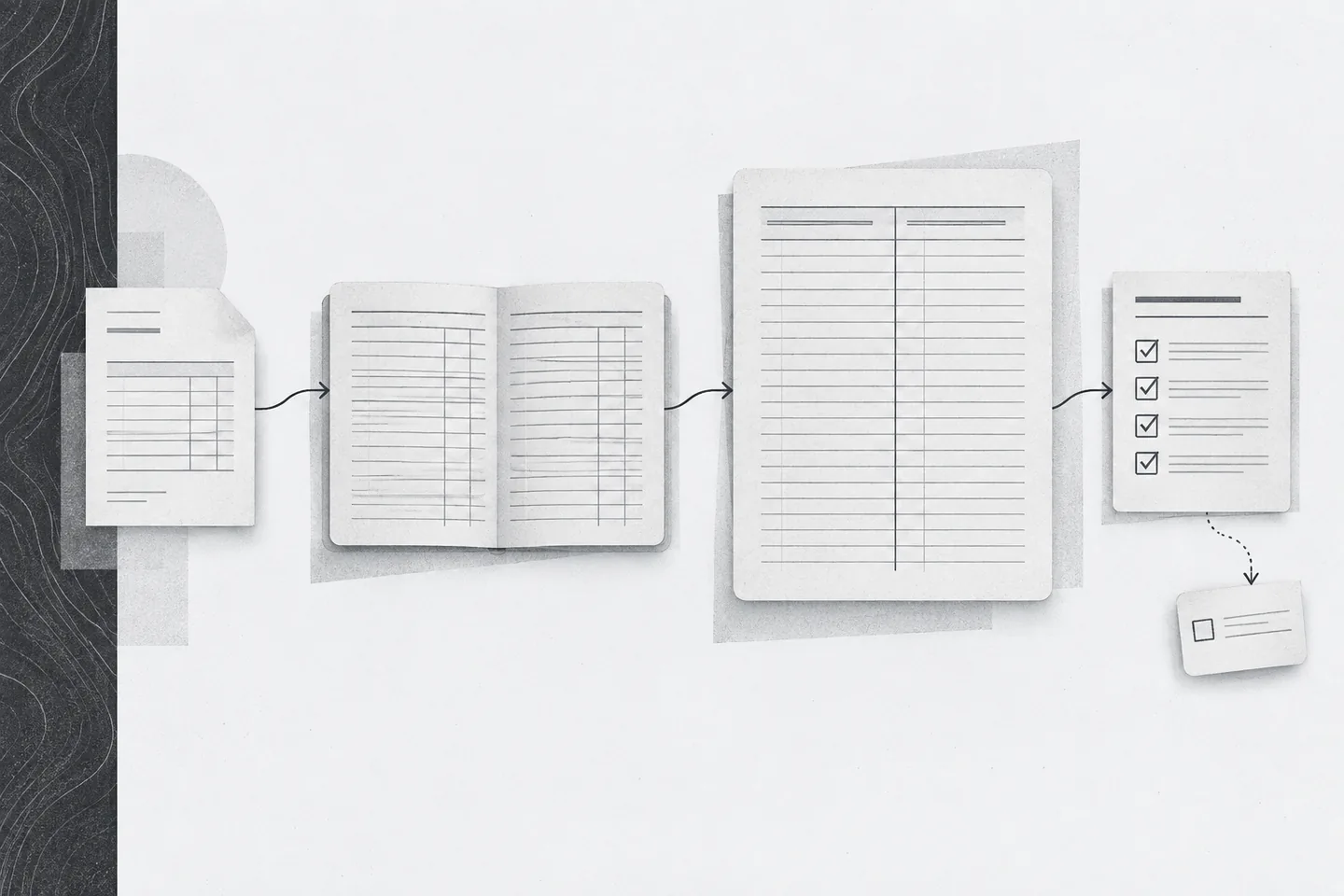
A monthly close should leave a clear path from each reported balance to the transaction and record that support it. For a small business, the sequence is to collect documents, record transactions, review balances, resolve exceptions and issue reports.
OpenStax describes its initial steps as identifying and analysing transactions, recording them in a journal, posting them to a ledger and preparing an unadjusted trial balance. The checklist turns those steps into a review process and distinguishes monthly reporting from formal closing entries.
Follow one transaction through the records
Suppose a service business completes a job in June and issues a 600 invoice. It uses accrual accounting, and the customer has not paid by 30 June. The example does not apply to every accounting method.
- Keep the source document. Save the invoice with its date, description, customer, amount and a reference that can be found again. Confirm that the work was completed and that the invoice belongs in June. The IRS identifies invoices and other supporting documents as records that supply information for book entries and support amounts reported for tax purposes.
- Record the journal entry. On the assumed accrual basis, debit accounts receivable 600 and credit service revenue 600. The journal entry records both sides of the event: the customer owes the business, and the business has earned revenue. Include the invoice reference so a reviewer can return to the document.
- Post to the ledger. The 600 debit appears in accounts receivable; the 600 credit appears in service revenue. Each account's ending balance reflects all its postings.
- Check the trial balance. After June’s entries are posted, the unadjusted trial balance lists the ending balance of each ledger account. If this were the only transaction in a new set of books, it would show 600 in the debit column for accounts receivable and 600 in the credit column for service revenue. In real books, those balances will usually include other activity. OpenStax explains that a trial balance carries account balances from the ledger, rather than listing every individual posting.
Equal debit and credit totals do not prove completeness or correct classification. An invoice entered twice, dated in the wrong month or credited to the wrong revenue account may leave the columns equal. Reconciliation and review remain necessary.
Turn the cycle into a monthly close
Set the reporting period and gather sales invoices, supplier bills, receipts, bank and card statements, payroll support where applicable, and schedules for loans, inventory or equipment. Keep records where ledger entries can be matched to them. A bank line shows that money moved but may not explain the purchase or account choice.
Check that transactions were entered once, in the right period and account. Compare invoice sequences or sales-system totals with revenue, and bills received with payables and payments. Review the month boundary: a July invoice may relate to June work, while a June payment may settle an earlier obligation. The entry depends on the accounting basis and underlying facts.
Reconcile cash and other material balance-sheet accounts to independent records or supporting schedules. For a bank account, compare the ledger with the statement and explain outstanding items rather than forcing an adjustment to make the figures match. For receivables, compare the ledger balance with the customer invoice list and investigate old or negative balances. For payables, compare the ledger with the unpaid-bill list and supplier information available. Review loans, payroll liabilities and other accounts relevant to the business with the same question: what supports this balance at month-end?
Consider adjustments for an unpaid June cost, a payment covering several months or depreciation, even without a new bank transaction at month-end. Document each calculation, period and approval. After posting approved adjustments, prepare an adjusted trial balance for the reports.
Keep an exception list before issuing reports
Keep unresolved questions in one exception list. Record each item's amount, period, source reference, owner, next step and resolution. Look for:
- Missing records: a payment without an invoice or receipt, an invoice absent from the ledger, or a balance without a supporting schedule. Seek the document or establish what other reliable evidence is available.
- Possible duplicates: the same supplier bill imported and entered manually, repeated invoice numbers, or two postings for one bank movement. Check the source and posting history before reversing anything.
- Unclear categories: a cost labelled only “miscellaneous,” an owner transaction mixed with operating expenses, or a purchase that might be an asset rather than a current expense. Resolve the underlying facts before selecting an account.
- Unexplained differences: a reconciliation that does not agree, an unusual credit balance, or a sharp movement from the previous month without supporting activity.
Do not clear an exception merely because the debit and credit totals match. Escalate items that could materially change a report, and hold the report if a reliable figure cannot yet be established. For less consequential open items, document the assessment, the person who accepted it and the follow-up date. The list should make uncertainty visible to the report’s reader, not conceal it inside a balancing entry.
A repeatable monthly evidence checklist
Use the same checklist each month and retain evidence of completion. A small business may combine roles, but each check still needs an identifiable reviewer.
- Define the period. Record the month-end date, accounting basis, reporting scope and the person responsible for the close.
- Collect source records. File sales, purchases, bank, card and payroll support as applicable. Note missing documents in the exception list.
- Check completeness and duplicates. Compare source-system totals and document sequences with recorded entries; inspect repeated amounts and references.
- Review the journal and ledger. Check dates, descriptions, account choices and references for unusual or material entries.
- Prepare the unadjusted trial balance. Confirm that its account balances agree with the ledger and that total debits equal total credits.
- Reconcile supported balances. Save the bank reconciliation and schedules for receivables, payables and other material accounts. Explain differences and identify outstanding items.
- Record reviewed adjustments. Retain calculations and approvals, then prepare the adjusted trial balance.
- Resolve or disclose exceptions. Confirm which items are closed, which remain open and whether any open item affects the reliability of the reports.
- Issue and retain reports. Save the final reports with the trial balance, reconciliations, adjustment support, exception list and review sign-off so the figures can be traced later.
Retain the saved records and review behind any software status reading “reconciled”.
Month-end review is distinct from year-end closing entries
Businesses often call this monthly process a “close”: they finish entry and review, issue reports and may restrict changes to the period. Formal closing entries have a narrower accounting meaning. They transfer balances from temporary accounts, such as revenue and expenses, into equity so those accounts begin the next accounting period at zero. Asset and liability balances carry forward.
OpenStax distinguishes monthly reporting from annual book closing, while also showing that closing entries can be made at the end of a chosen accounting period. The practice depends on the business’s reporting setup. A monthly profit report does not, by itself, mean revenue and expense accounts were formally closed in the ledger that month.
At year-end, the business should first complete the familiar evidence work across the final period: reconcile balances, resolve significant exceptions, review adjustments and prepare financial statements. It then records the closing entries required by its accounting process and checks the post-closing trial balance. The monthly routine builds the record that makes this later work possible; the year-end entries reset temporary accounts for the next annual period.
A reported number should be traceable through the adjusted trial balance, ledger and journal to its source record. Investigate breaks in that chain before relying on the report.