
Business note
Cash vs. Accrual Accounting: A Timing Example for Small Businesses
All figures in the worked examples use illustrative accounting units. Cash and accrual accounting can report the same job in different periods. Under the…
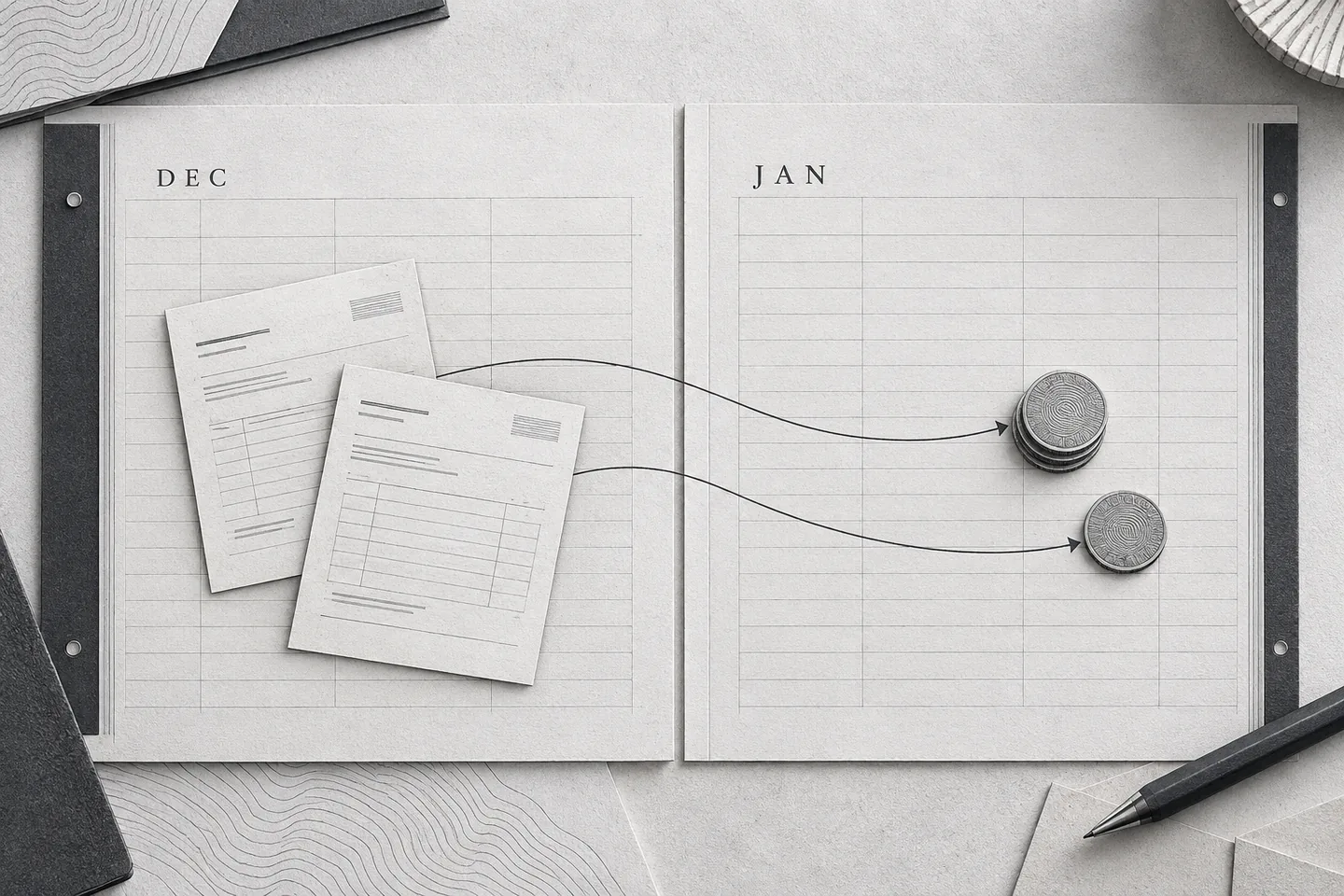
All figures in the worked examples use illustrative accounting units.
Cash and accrual accounting can report the same job in different periods. Under the cash method, income is generally recorded when received and expenses when paid. Under the accrual method, income is generally recorded when earned and expenses when the liability arises, subject to further tax rules. The work, invoices and payments do not change; their place in the accounts does. The IRS explains these general timing rules in Publication 538.
Consider a small service business that finishes a project in December and invoices its customer for 5,000. A supplier completes 1,800 of services for that project in December and sends a bill. The customer pays in January, when the business also pays the supplier. Assume both amounts are fixed, both services are complete in December, and there are no advance payments. This example shows timing only. It does not establish which tax method the business may use or calculate its taxable income.
The same transactions in two periods
By 31 December, the business has finished the customer work and owes its supplier, but neither payment has moved through its bank account. By the end of January, it has collected 5,000 and paid 1,800. The difference is 3,200 under either method across the two months. The methods put that difference in different periods:
- Cash method: December shows no income or expense from these two transactions. January shows 5,000 of income and 1,800 of expense, a 3,200 difference.
- Accrual method: December shows the 5,000 earned from the completed project and the 1,800 cost of the completed supplier service, a 3,200 difference. January's collection and payment settle balances already recorded; they do not create the same income and expense again.
These figures describe one job, not the business's full monthly result. They also assume the supplier's service is an ordinary expense. Equipment, inventory or a cost that must be capitalised would require a different treatment.
What the cash method tells you
Issuing an invoice in December does not, by itself, put the 5,000 into December cash-method income. Receiving the supplier's bill does not, by itself, put the 1,800 expense there either. On the stated facts, both amounts appear in January. The IRS’s Tax Guide for Small Business describes the cash-method rules, including qualifications for constructive receipt and payments made in advance.
January's 3,200 difference therefore does not mean the work happened in January. Equally, December's zero for this job does not mean the business had no work or obligations. The invoice records an expected collection; the supplier bill records an amount to pay. A cash-method income report needs those records alongside it if an owner wants to understand work completed but not yet paid for.
A bank balance is narrower still. It shows money available at a point in time, not whether a customer owes the business for finished work or whether a supplier has already delivered a service. A January receipt may be needed to meet a January payment even though both relate to December activity. Keeping an invoice list and a bill list helps make that commitment visible before the money moves.
What the accrual method tells you
Under the simplified accrual example, the completed customer work belongs in December's income if the right to payment is fixed and the amount can be determined with reasonable accuracy. The supplier's completed service belongs in December's expense if the liability is fixed, its amount can be determined and economic performance has occurred. The invoice and bill support those entries. In January, receiving the customer payment clears the receivable; paying the supplier clears the payable.
Those two stages should remain traceable. In December, record the completed work, the amount due from the customer, the supplier's service and the amount owed. In January, match the bank movements to those outstanding balances. OpenStax describes the accounting cycle as identifying and recording transactions before posting and reporting them. Retaining the invoice, bill and payment references makes it easier to check whether an item was omitted or counted twice.
The accrual view puts the 3,200 difference beside the work that produced it. It does not say that 3,200 was available to spend in December. The business still had to collect from its customer and pay its supplier. A report of recorded income and expenses explains activity for a period; a cash forecast addresses when funds will arrive and leave. An owner may need both to plan a supplier payment without confusing an earned amount with cash on hand.
Why December and January matter
These months fall in different calendar years. In the example, the cash method places both amounts in the later year and the accrual method places them in the earlier one. That makes the choice of method more consequential than a shift between two months within the same year. The example assumes a calendar-year business; a business with a different tax year must use its own year boundary.
Tax treatment can depart from this tidy illustration. A cash-method taxpayer can have income through constructive receipt before depositing a payment. An accrual-method taxpayer must consider when its right to income is fixed and, for an expense, when the liability and economic performance tests are met. Advance payments and capitalised costs have their own rules. A date on an invoice is evidence to examine, not an automatic answer to every recognition question.
Keep management and tax reports connected
A manager might use a December report to compare completed projects with their related costs, then use a January cash report to plan payments. Each report should identify its period and basis. Labelling a figure merely as “profit” hides whether it describes work performed, cash movement or a wider result after other costs. The example's 3,200 is just the difference between two specified amounts.
A short reconciliation can list the December customer invoice and supplier bill, their January settlement dates, and the entries each report includes. Match the receivable to the later receipt and the payable to the later withdrawal. Check that neither transaction appears twice and that unpaid items remain visible at the period end. This gives someone reviewing the figures a path from source document to report, rather than asking them to infer the method from a total.
For tax, a business cannot select a method separately for each transaction simply because one date gives a preferred result. The appropriate method depends on its circumstances and must be applied consistently. A management schedule using another view needs a clear bridge to the tax records. Before changing an established tax accounting method, the business should check the applicable IRS procedure and its own facts with a qualified accountant; changing a software setting alone does not make the change valid.
Limits of the example
The service example excludes inventory. Buying or producing goods can introduce inventory and cost rules that do not follow a simple bill-and-payment timeline, although small-business exceptions may apply. The example also excludes deposits, disputed invoices, long contracts and assets bought for use over several years. Each can change which amount belongs in which period. Check the current guidance and the underlying documents before applying this comparison to a return.
For an ordinary project, keep the dates together: when the work was done, when the customer was invoiced, when the supplier billed, and when each payment cleared. Record the amount and document behind each entry, then state the accounting basis on the report. That makes the December and January figures intelligible without treating either method as a substitute for the actual transaction history.